Recall
Connect each guru to the phrases most strongly associated with his work.
 UpSkill Sprint Consulting
Quality Engineering · Beginner · 45 minutes
Three thinkers shaped modern quality management—but they did not ask the same question. Learn each lens, see how the ideas work together, and recognize the exam clues that separate them.
Quality engineering · Big picture
Select a stage to explore the system, choose a guru to trace his leadership lens, or pause the motion at any time.
Meaning: Quality begins with customer needs and clear requirements—not with inspection alone.
Management system: Planning, assurance, control, improvement, standards, and execution must work together.
Leadership lenses: Crosby, Juran, and Deming help managers strengthen different—but connected—parts of that system.
Start with the outcome
By the end, you should be able to explain the gurus in plain language and choose the right philosophy for a practical or exam-style situation.
Connect each guru to the phrases most strongly associated with his work.
Separate conformance to requirements, fitness for use, and system improvement.
Use all three lenses to improve a real manufacturing process without treating the ideas as competing slogans.
The mental model
The fastest way to learn the gurus is to understand the managerial problem each one helps you solve.
Philip Crosby
Definition: conformance to requirements.
Signature: four absolutes, prevention, Zero Defects, price of nonconformance.
Joseph Juran
Definition: fitness for use.
Signature: planning, control, improvement, and the vital few.
W. Edwards Deming
Primary lens: the organization as an interdependent system.
Signature: 14 Points, variation, System of Profound Knowledge, and PDSA.
| Question | Crosby lens | Juran lens | Deming lens |
|---|---|---|---|
| What is quality? | Conformance to requirements | Fitness for use | A result of improving the system for the customer |
| How is quality achieved? | Prevention | Planning, control, and improvement | Leadership, understanding variation, and continual learning |
| What phrase is the strongest clue? | Zero Defects | Quality Trilogy | 14 Points or PDSA |
| What should management examine? | Requirements and nonconformance costs | Customer needs and chronic waste | The interactions and variation within the whole system |
Guru 1 · Philip Crosby
Crosby’s four absolutes convert “quality” from a vague compliment into a management system with a definition, a method, a standard, and a financial measure.
Executive language for quality: define the requirement, prevent the miss, and express failure in dollars.
Crosby made quality legible to senior leaders by connecting conformance, prevention, Zero Defects, and the price of nonconformance to operating performance.
Quality means conformance to requirements.
A product is not high quality because it is luxurious. It is high quality when it meets clear, valid requirements.
The quality system is prevention.
Build controls into material selection, setup, calibration, work methods, and process design instead of depending on final inspection.
The performance standard is Zero Defects.
Do not plan a defect allowance as the target. “Do it right the first time” sets the direction for performance.
The measurement of quality is the price of nonconformance.
Translate failure into money: scrap, rework, retesting, delay, warranty, returns, complaint handling, and lost business.
Suppose a pipe must have wall thickness of 10.0 ± 0.5 mm, yield strength of at least 450 MPa, and length of 12.0 ± 0.1 m. Under Crosby’s definition, quality means meeting all applicable requirements. A premium finish cannot compensate for a failed strength requirement.
Change the illustrative monthly failure costs. The total updates when you select Calculate PONC.
Guru 2 · Joseph Juran
Juran broadens the question from “Did it meet a written requirement?” to “Will it satisfy the customer in actual use?” Then he gives managers a trilogy for making that happen.
Managerial architecture for quality: plan what customers need, control the process, and lead breakthrough improvement.
Juran treated quality as a management responsibility spanning product design, operational control, project-by-project improvement, and the human side of change.
Identify customers, determine their needs, translate those needs into product and process requirements, and develop a process capable of meeting them.
Question: What must we design so the customer succeeds?
Evaluate actual performance, compare it with the goal, and act on the difference so routine performance stays on target.
Question: Are we holding the intended level?
Remove chronic causes and reach a new level of performance through focused, project-by-project breakthrough.
Question: How do we escape the current plateau?
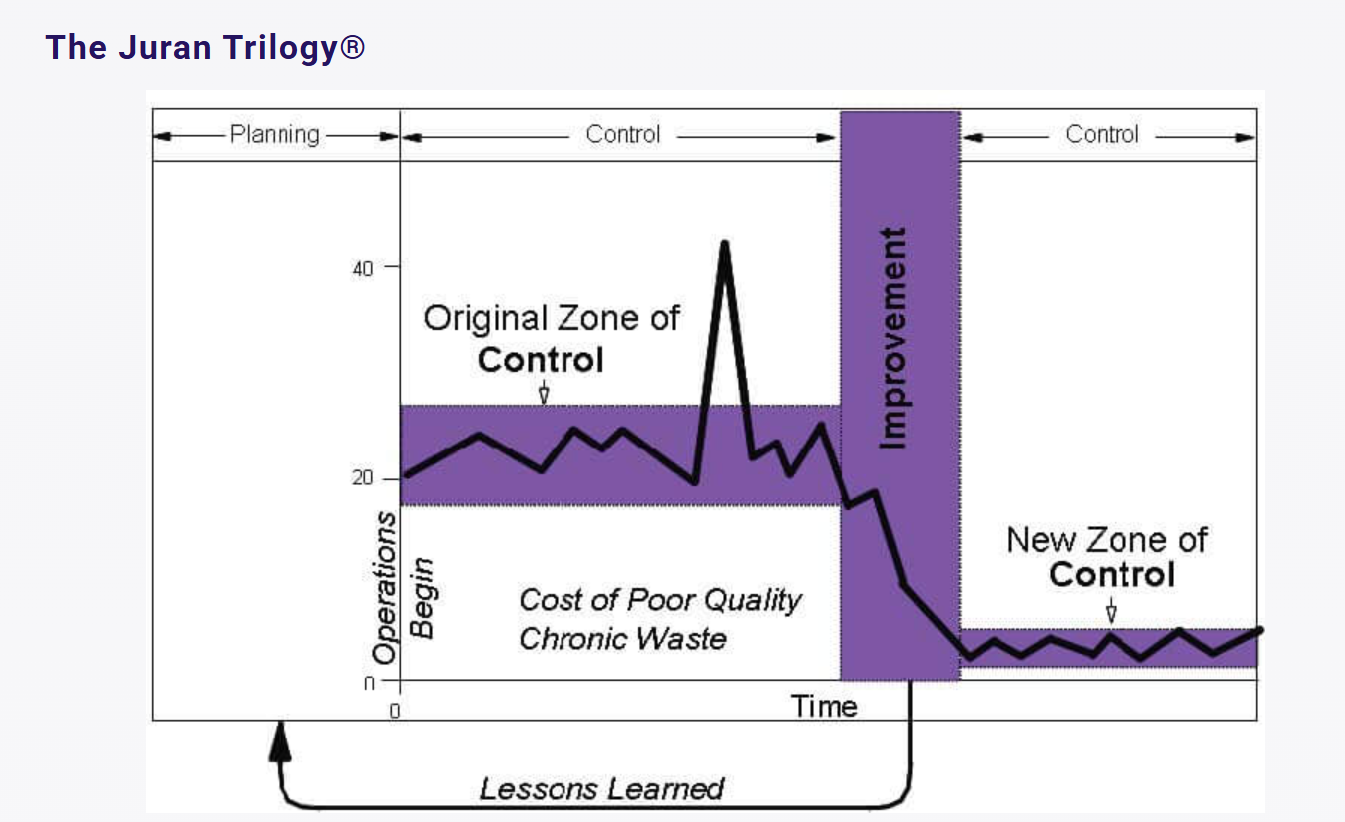
Identify customers and needs, translate those needs into requirements, and design a process intended to meet them. When operations begin, the process inherits the capabilities and weaknesses built during planning.
The original control zone shows routine performance fluctuating around a stable level. Control detects and removes a sporadic spike, but returning to the old level still leaves the underlying chronic waste in place.
A breakthrough project removes a chronic cause and shifts performance to a lower, better zone of control. Updated standards and controls prevent backsliding, while lessons learned strengthen the next planning cycle.
A small number of causes often account for a large share of a problem. Juran called these the vital few; the remaining causes are the useful many.
The familiar 80/20 split is a rule of thumb, not a law. Use the actual data to find where effort will have the greatest effect.
A customer needs a pipe to perform safely under specified service conditions. Quality planning converts that need into material grade, dimensional tolerances, welding controls, test requirements, traceability, and release criteria. Quality control monitors the selected measures. Quality improvement attacks chronic losses that the control system has merely been holding steady.
Guru 3 · W. Edwards Deming
Deming placed responsibility on management to create an environment where interdependent processes, useful data, scientific learning, and people can work together.
A theory of management: improve the system, understand variation, test predictions, and let people take pride in their work.
Deming’s contribution is larger than a single tool. His System of Profound Knowledge connects systems thinking, statistical reasoning, learning theory, and psychology.
Imagine Purchasing is rewarded only for the lowest material price. It buys inconsistent material, Production experiences more downtime, Quality sees more failures, and Shipping misses dates. Purchasing met its local target while the organization performed worse. This is suboptimization.
Optimize the whole system—not isolated departments.This four-part framework helps managers see why a technically correct local fix can still fail.
Understand how suppliers, processes, teams, customers, and goals interact.
Distinguish routine system variation from a specific, assignable event.
Make a prediction, test it, compare results with the prediction, and learn.
Understand motivation, fear, cooperation, learning, and how people experience the system.
| Variation type | Meaning | Best response | Wrong response |
|---|---|---|---|
| Common cause | Routine variation built into the current system | Management changes the system | Blame one operator or adjust the process after every ordinary fluctuation |
| Special cause | An unusual, identifiable event outside routine behavior | Find and address the specific cause | Redesign the whole process before investigating the event |
The short descriptions below preserve the major exam-level themes. They are shown in Deming’s numbered order.
Integrated application
A 24-inch ERW line has a stable 4% weld-repair rate, repeated testing delays, and growing customer complaints. The example is illustrative. Watch how each lens changes the management response.
Clarify the weld acceptance requirements, reject “4% is normal” as the performance standard, mistake-proof critical setup steps, and calculate the PONC from repairs, testing, delay, sorting, claims, and lost capacity.
Translate fitness for use into critical-to-quality requirements, maintain a control plan for routine production, use Pareto analysis to select the vital few drivers, and charter an improvement project to reduce the chronic 4% level.
Examine material, setup, welding, maintenance, measurement, incentives, and handoffs as one system. Separate common from special causes, remove fear around reporting problems, and run a small PDSA test with a stated prediction.
Use customer requirements to define success, prevention to avoid recurrence, process control to hold the gain, PDSA to keep learning, and financial measures to show why the change matters.
Retrieval practice
Some ideas overlap. Choose the guru most directly associated with each statement.
Complete all six matches, then check your reasoning.
Exam readiness
Use the wording in the question. Identify the distinctive phrase before choosing an answer.
| If you see this phrase | Think | Why |
|---|---|---|
| Conformance to requirements, prevention, Zero Defects, price of nonconformance | Crosby | These are the four absolutes. |
| Fitness for use, Trilogy, breakthrough, vital few | Juran | These phrases connect customer use, managerial processes, and prioritization. |
| 14 Points, drive out fear, system, variation, PDSA, tampering | Deming | These clues point to management-led system improvement and learning. |
Final review
Define quality as conformance to requirements. Prevent defects, set Zero Defects as the standard, and measure the price of nonconformance.
Define quality as fitness for use. Manage it through planning, control, and improvement; focus on the vital few causes.
Improve the entire system. Understand variation, lead without fear, and learn through repeated PDSA cycles.
Knowledge check
Pick the strongest answer, then submit. Explanations appear after you submit.